When couples experience difficulty conceiving, identifying the underlying cause of infertility is an important part of fertility care. Sometimes, conditions affecting the uterus, fallopian tubes, ovaries, or pelvis may contribute to fertility problems.
Hysteroscopy and laparoscopy are minimally invasive procedures that can help fertility specialists examine and, in selected cases, treat certain reproductive health conditions.
At Ambe Fertility Centre and Shree IVF Centre, Kurnool, fertility specialists may recommend hysteroscopy or laparoscopy when clinically appropriate as part of a comprehensive fertility evaluation.
In this article, we explain what hysteroscopy and laparoscopy are, how these procedures work, when they may be recommended, their benefits, recovery, and frequently asked questions.
What Is Hysteroscopy?
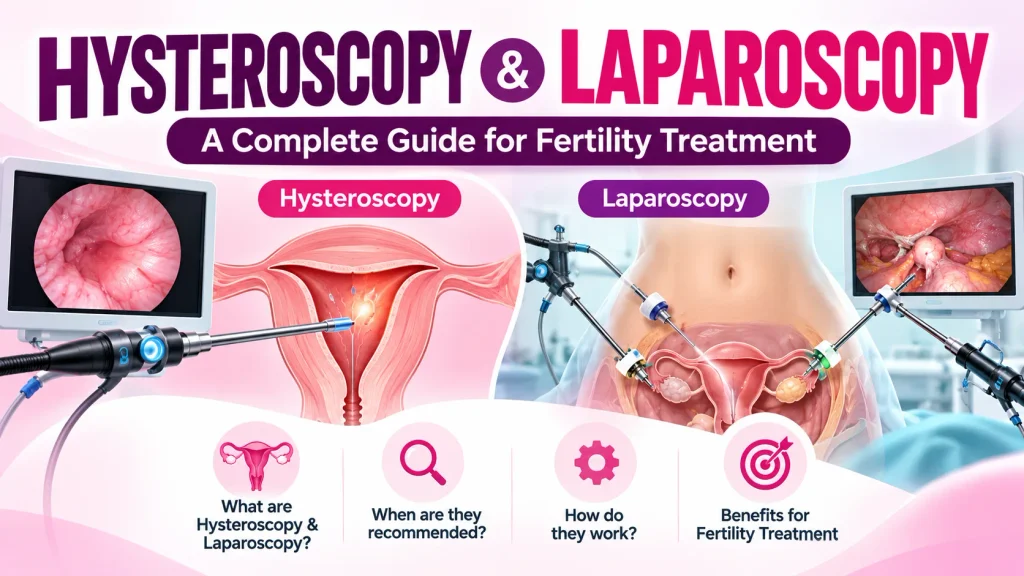
Hysteroscopy is a minimally invasive procedure used to examine the inside of the uterus.
During hysteroscopy, a thin instrument called a hysteroscope, which has a camera and light, is gently passed through the vagina and cervix into the uterus.
This allows the doctor to directly view the uterine cavity and identify certain abnormalities that may affect fertility or pregnancy.
Depending on the patient’s condition, hysteroscopy may be used for both diagnosis and treatment.
What Conditions Can Hysteroscopy Detect?
Hysteroscopy may help identify certain conditions inside the uterus, including:
- Uterine polyps
- Submucosal fibroids
- Uterine adhesions
- Scar tissue inside the uterus
- Certain uterine cavity abnormalities
- Some causes of abnormal uterine bleeding
- Selected conditions that may affect embryo implantation
If an abnormality is identified, treatment may sometimes be performed during the same procedure, depending on the condition and medical assessment.
What Is Laparoscopy?
Laparoscopy is a minimally invasive surgical procedure used to examine the organs inside the abdomen and pelvis.
A thin camera called a laparoscope is inserted through a small incision, usually near the navel. Additional small incisions may be made if surgical treatment is required.
Laparoscopy allows the fertility specialist or gynecological surgeon to examine structures such as:
- Uterus
- Fallopian tubes
- Ovaries
- Pelvic tissues
- Areas around the reproductive organs
It can help identify certain conditions that may not be fully detected through routine scans.
What Conditions Can Laparoscopy Detect?
Depending on the clinical situation, laparoscopy may help diagnose or treat:
- Endometriosis
- Pelvic adhesions
- Certain ovarian cysts
- Tubal abnormalities
- Certain pelvic infections or scarring
- Some causes of unexplained pelvic pain
- Selected reproductive conditions affecting fertility
If a treatable abnormality is found, appropriate surgical treatment may sometimes be performed during the same procedure.
Hysteroscopy vs Laparoscopy: What Is the Difference?
Although both are minimally invasive procedures, they examine different areas.
Hysteroscopy
Hysteroscopy examines the inside of the uterus.
It is particularly useful for identifying abnormalities within the uterine cavity, such as polyps, adhesions, or certain fibroids.
Laparoscopy
Laparoscopy examines the outside of the uterus and other pelvic organs, including the ovaries and fallopian tubes.
It can be particularly useful for diagnosing conditions such as endometriosis, pelvic adhesions, and certain tubal abnormalities.
Simple Comparison
| Feature | Hysteroscopy | Laparoscopy |
|---|---|---|
| Main area examined | Inside the uterus | Pelvic and abdominal organs |
| Instrument used | Hysteroscope | Laparoscope |
| Common uses | Polyps, adhesions, uterine cavity abnormalities | Endometriosis, adhesions, tubal and ovarian conditions |
| Incisions | Usually no abdominal incision | Small abdominal incisions |
| Can treatment be performed? | Yes, in selected cases | Yes, in selected cases |
Why Are Hysteroscopy and Laparoscopy Important in Fertility Treatment?
Successful conception depends on several factors, including healthy eggs and sperm, functioning fallopian tubes, and a healthy uterine environment.
Certain reproductive conditions may interfere with conception or implantation.
Hysteroscopy and laparoscopy can help fertility specialists obtain additional information when routine fertility investigations do not provide a complete explanation.
They may also allow certain abnormalities to be treated when appropriate.
However, not every patient undergoing fertility treatment requires hysteroscopy or laparoscopy. The decision depends on the individual’s symptoms, medical history, examination, fertility test results, and treatment plan.
When May Hysteroscopy Be Recommended?
A fertility specialist may consider hysteroscopy in selected situations such as:
- Suspected uterine polyps
- Suspected submucosal fibroids
- Recurrent implantation problems
- Recurrent pregnancy loss in selected cases
- Suspected uterine adhesions
- Abnormal uterine bleeding
- Abnormal findings on ultrasound or other imaging
- Evaluation of the uterine cavity before selected fertility treatments
The procedure should only be performed when medically indicated.
When May Laparoscopy Be Recommended?
Laparoscopy may be considered in selected patients with:
- Suspected endometriosis
- Chronic pelvic pain
- Suspected pelvic adhesions
- Certain fallopian tube problems
- Previous pelvic surgery
- Certain ovarian conditions
- Infertility where a pelvic cause is suspected
- Selected cases of unexplained infertility
The fertility specialist will determine whether laparoscopy is appropriate based on the patient’s individual condition.
Hysteroscopy Procedure: What to Expect
The exact process varies depending on whether diagnostic or operative hysteroscopy is being performed.
Step 1: Pre-Procedure Evaluation
The doctor reviews your medical history, symptoms, fertility investigations, and any previous treatments.
Step 2: Preparation
The fertility specialist provides instructions regarding medications, food, fluids, and other preparation depending on the procedure and anesthesia plan.
Step 3: Hysteroscopy
The hysteroscope is gently introduced through the vagina and cervix into the uterus.
The doctor examines the uterine cavity using the camera.
Step 4: Treatment if Required
If a suitable abnormality is found and treatment is planned, selected problems such as polyps or certain fibroids may be treated during the procedure.
Step 5: Recovery
Recovery depends on the type of hysteroscopy performed. Many patients can return to normal activities relatively quickly, although individual instructions may vary.
Laparoscopy Procedure: What to Expect
Laparoscopy is generally performed under anesthesia.
Step 1: Pre-Surgical Evaluation
The medical team reviews your health, fertility history, previous surgeries, and relevant investigations.
Step 2: Anesthesia
Laparoscopy is usually performed under general anesthesia.
Step 3: Small Incisions
Small incisions are made in the abdomen to allow the laparoscope and other instruments to be inserted.
Step 4: Examination
The surgeon examines the uterus, ovaries, fallopian tubes, and surrounding pelvic structures.
Step 5: Treatment if Required
If conditions such as endometriosis, adhesions, or certain cysts are identified, appropriate treatment may sometimes be performed during the same surgery.
Step 6: Recovery
Because laparoscopy involves small abdominal incisions, recovery may take longer than diagnostic hysteroscopy. Your doctor will provide specific post-operative instructions.
Can Hysteroscopy and Laparoscopy Improve Fertility?
In selected patients, treating a condition identified during hysteroscopy or laparoscopy may improve the reproductive environment.
For example, treatment of certain uterine cavity abnormalities may help create a more suitable environment for implantation.
Similarly, treatment of certain conditions such as endometriosis or pelvic adhesions may be beneficial for selected patients.
However, these procedures do not guarantee pregnancy. Their potential benefit depends on the underlying fertility problem and the individual’s overall reproductive health.
Are Hysteroscopy and Laparoscopy Painful?
The experience varies depending on the procedure and whether it is diagnostic or operative.
Hysteroscopy may cause mild cramping or discomfort in some patients.
Laparoscopy is generally performed under anesthesia, so the procedure itself is not felt. Temporary abdominal discomfort, bloating, or shoulder-tip discomfort may occur during recovery in some patients.
Your medical team will provide appropriate pain management and recovery instructions.
Recovery After Hysteroscopy
Recovery after hysteroscopy depends on the type of procedure performed.
Some patients may experience:
- Mild cramping
- Light vaginal bleeding or spotting
- Temporary discomfort
Your doctor will advise when you can resume normal activities, exercise, and sexual activity.
Recovery After Laparoscopy
Recovery after laparoscopy may involve:
- Mild abdominal pain
- Bloating
- Tiredness
- Shoulder-tip discomfort
- Mild soreness around the incision sites
The recovery period varies depending on the type of surgery performed and the patient’s overall health.
Follow your doctor’s instructions regarding activity, medication, wound care, and follow-up appointments.
Hysteroscopy and Laparoscopy Before IVF
Not every patient needs hysteroscopy or laparoscopy before IVF.
However, in selected cases, a fertility specialist may recommend additional evaluation if there is a suspected uterine, tubal, ovarian, endometriosis-related, or pelvic problem.
The decision should be based on the patient’s medical history and fertility evaluation rather than performing these procedures routinely for everyone.
Hysteroscopy and Laparoscopy for Endometriosis
Endometriosis is a condition in which tissue similar to the lining of the uterus grows outside the uterus.
It may be associated with pelvic pain and difficulty conceiving.
Laparoscopy can help identify endometriosis and, in selected cases, allow treatment during the same surgical procedure.
Whether surgery is appropriate depends on factors such as symptoms, age, fertility goals, ovarian reserve, and previous fertility treatment.
Hysteroscopy and Laparoscopy for Tubal Problems
Fallopian tube health is important for natural conception.
Certain conditions such as pelvic adhesions, endometriosis, or previous infections may affect the fallopian tubes.
Laparoscopy may help evaluate the external appearance of the tubes and surrounding pelvic structures. Additional testing may be used to assess whether the tubes are open.
The fertility specialist will recommend the appropriate investigation based on the patient’s condition.
Possible Risks of Hysteroscopy and Laparoscopy
Although these are commonly performed minimally invasive procedures, all medical procedures can have potential risks.
Hysteroscopy risks may include:
- Infection
- Bleeding
- Uterine injury
- Cervical injury
- Rare complications related to anesthesia or the procedure
Laparoscopy risks may include:
- Infection
- Bleeding
- Injury to surrounding organs
- Blood clots
- Anesthesia-related complications
- Rare complications related to abdominal surgery
Your doctor will explain the potential risks and benefits before the procedure.
Why Choose Ambe Fertility Centre and Shree IVF Centre in Kurnool?
Choosing an experienced fertility centre is an important part of your fertility journey.
Ambe Fertility Centre and Shree IVF Centre, Kurnool, provides fertility evaluation, counseling, and treatment planning based on each couple’s individual needs.
If your fertility specialist suspects a uterine, tubal, ovarian, endometriosis-related, or pelvic condition, hysteroscopy or laparoscopy may be considered when medically appropriate.
For couples looking for hysteroscopy and laparoscopy in Kurnool, professional fertility consultation can help determine whether these procedures are suitable for their specific situation.
Frequently Asked Questions About Hysteroscopy and Laparoscopy
1. What is hysteroscopy?
Hysteroscopy is a minimally invasive procedure used to examine the inside of the uterus using a thin camera called a hysteroscope.
2. What is laparoscopy?
Laparoscopy is a minimally invasive surgical procedure used to examine the pelvic and abdominal organs through small incisions.
3. What is the difference between hysteroscopy and laparoscopy?
Hysteroscopy examines the inside of the uterus, while laparoscopy examines the outside of the uterus, ovaries, fallopian tubes, and other pelvic structures.
4. Can hysteroscopy help with infertility?
In selected patients, hysteroscopy can identify and sometimes treat uterine abnormalities that may affect fertility or implantation.
5. Can laparoscopy help diagnose endometriosis?
Yes. Laparoscopy can help directly identify endometriosis and may allow treatment during the same procedure in selected cases.
6. Is hysteroscopy required before IVF?
No. Hysteroscopy is not routinely required for every IVF patient. It may be recommended when there is a specific medical indication.
7. Is laparoscopy required before IVF?
Not necessarily. The need for laparoscopy depends on the patient’s symptoms, fertility history, test results, and suspected pelvic conditions.
8. How long does recovery take after laparoscopy?
Recovery varies depending on the type of surgery performed and the patient’s health. Your surgeon will provide individualized recovery instructions.
9. Can hysteroscopy and laparoscopy improve pregnancy chances?
Treating certain fertility-related abnormalities may improve reproductive outcomes in selected patients, but neither procedure can guarantee pregnancy.
10. Where can I get hysteroscopy and laparoscopy in Kurnool?
Patients looking for fertility evaluation and guidance regarding hysteroscopy and laparoscopy in Kurnool can consult the specialists at Ambe Fertility Centre and Shree IVF Centre, Near Spencer’s (Value Mart), Opp. RTC Bus Stand, Bellary Road, Kurnool.
Consult a Fertility Specialist in Kurnool
If you have been trying to conceive or have experienced repeated fertility difficulties, identifying the underlying cause is an important first step.
At Ambe Fertility Centre and Shree IVF Centre, Kurnool, fertility specialists provide personalized evaluation and guidance for conditions that may affect conception, implantation, or reproductive health.
If you have been advised to consider hysteroscopy or laparoscopy, our fertility team can help you understand the procedure, its purpose, potential benefits, and whether it may be appropriate for your fertility treatment plan.
Ambe Fertility Centre and Shree IVF Centre
Address: Near Spencer’s (Value Mart), Opp. RTC Bus Stand, Bellary Road, Kurnool – 518002
Phone: 7396578258
Email: ambefertilitycentre@gmail.com
Book a fertility consultation to understand your fertility evaluation and treatment options.