
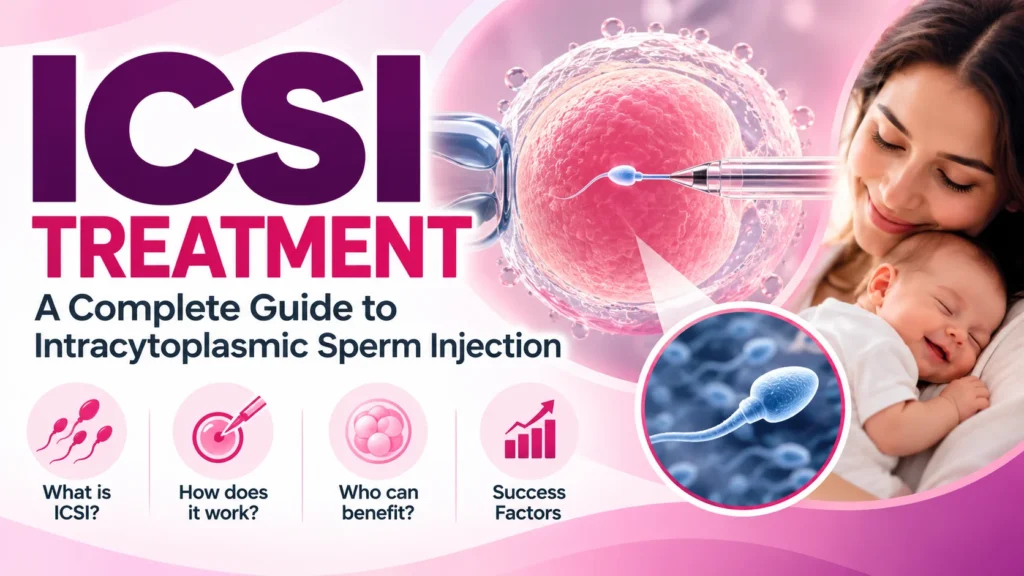
For couples experiencing difficulty conceiving, advanced fertility treatments can provide additional options when conventional treatments may not be successful. Intracytoplasmic Sperm Injection (ICSI) is an advanced assisted reproductive technique commonly used as part of IVF treatment.
ICSI can be particularly useful in selected cases of male-factor infertility, previous IVF fertilization problems, or when only a small number of suitable sperm are available.
At Ambe Fertility Centre and Shree IVF Centre, Kurnool, fertility specialists evaluate each couple’s individual fertility needs and recommend appropriate treatment options based on their medical history, fertility tests, and reproductive health.
In this article, we explain what ICSI treatment is, how ICSI works, who may benefit from ICSI, the ICSI procedure, its benefits, success factors, and the difference between ICSI and conventional IVF.
What Is ICSI Treatment?
ICSI stands for Intracytoplasmic Sperm Injection.
It is a specialized fertilization technique used during an IVF cycle. In ICSI, a single selected sperm is carefully injected directly into a mature egg using specialized laboratory equipment.
The purpose of ICSI is to help the sperm fertilize the egg when natural fertilization may be difficult.
After fertilization, the resulting embryo may be monitored in the laboratory. Depending on the treatment plan, a suitable embryo can then be transferred into the woman’s uterus.
How Does ICSI Treatment Work?
ICSI is generally performed as part of an IVF treatment cycle. The process may involve several stages.
1. Fertility Evaluation
Before starting treatment, the fertility specialist evaluates both partners.
Depending on the individual’s circumstances, evaluation may include:
- Medical and fertility history
- Semen analysis
- Hormonal tests
- Ovarian reserve assessment
- Ultrasound examination
- Assessment of the uterus and reproductive organs
- Other fertility investigations when required
The results help the fertility team understand the possible causes of infertility and determine an appropriate treatment approach.
2. Ovarian Stimulation
During an IVF-ICSI cycle, fertility medications may be prescribed to stimulate the ovaries to develop multiple follicles.
The development of follicles is monitored through ultrasound examinations and, when required, blood tests.
3. Egg Retrieval
When the follicles reach an appropriate stage of development, the fertility specialist plans egg retrieval.
The eggs are collected from the ovaries using a specialized procedure under appropriate medical supervision.
4. Sperm Collection and Preparation
A semen sample is usually collected from the male partner on the day of egg retrieval.
The laboratory team processes the sample and identifies suitable sperm for the ICSI procedure.
In certain situations, sperm may need to be obtained through a medical procedure if sperm are not present in the ejaculated semen.
5. Sperm Injection Into the Egg
This is the key step of ICSI.
Using a specialized micromanipulation technique, an embryologist selects an individual sperm and injects it directly into a mature egg.
This is different from conventional IVF, where eggs and sperm are placed together in a laboratory dish and fertilization occurs without directly injecting the sperm into the egg.
6. Fertilization and Embryo Development
After ICSI, the fertilized eggs are monitored in the embryology laboratory.
Embryos are observed as they develop, and the fertility team determines the appropriate next step based on the individual treatment plan.
7. Embryo Transfer
When an embryo is considered suitable for transfer, it may be placed into the uterus through a thin catheter.
The timing and number of embryos transferred are decided according to the patient’s medical circumstances and the fertility specialist’s recommendations.
Who May Benefit From ICSI Treatment?
ICSI may be considered for selected couples experiencing certain fertility challenges.
It may be recommended in situations such as:
- Severe male-factor infertility
- Low sperm count
- Poor sperm movement
- Abnormal sperm morphology
- Previous IVF cycle with low or failed fertilization
- Very few available sperm
- Surgically retrieved sperm
- Certain cases involving frozen sperm or eggs
- Selected cases of unexplained infertility
- Use of previously frozen eggs
- Certain situations where fertilization with conventional IVF may be less likely
ICSI is not automatically required for every IVF cycle. A fertility specialist determines whether ICSI is appropriate based on the couple’s individual circumstances.
ICSI for Male Infertility
One of the most common reasons ICSI is considered is male-factor infertility.
Problems such as low sperm concentration, reduced sperm motility, or certain sperm abnormalities can make fertilization more difficult.
Because ICSI involves injecting a selected sperm directly into an egg, it can help overcome some barriers to fertilization in selected cases.
However, ICSI does not correct every cause of male infertility, and the overall treatment plan depends on the underlying condition.
ICSI vs IVF: What Is the Difference?
ICSI and conventional IVF are both assisted reproductive techniques, but the fertilization process is different.
Conventional IVF
In conventional IVF, eggs and sperm are placed together in a laboratory dish. The sperm must naturally penetrate the egg to achieve fertilization.
ICSI
In ICSI, an embryologist directly injects a single selected sperm into a mature egg.
ICSI vs IVF at a Glance
| Feature | Conventional IVF | ICSI |
|---|---|---|
| Fertilization method | Egg and sperm are placed together | Single sperm is injected into the egg |
| Sperm selection | Sperm fertilizes egg naturally in the laboratory | Individual sperm is selected by the embryologist |
| Common use | Various causes of infertility | Particularly useful in selected male-factor cases |
| Egg retrieval | Required | Required |
| Embryo development | After fertilization | After fertilization |
The choice between conventional IVF and ICSI should be based on the fertility diagnosis and the recommendation of the fertility specialist.
What Are the Benefits of ICSI Treatment?
For appropriately selected patients, ICSI may offer several potential benefits:
- Can help overcome certain sperm-related fertilization difficulties
- Requires only one selected sperm for injection into each mature egg
- May be useful when sperm numbers are very low
- Can be considered when previous IVF resulted in poor or failed fertilization
- Can be used with surgically retrieved sperm in selected cases
- Forms part of an advanced IVF treatment approach
It is important to understand that ICSI cannot guarantee pregnancy or a successful birth. Fertility treatment outcomes depend on multiple factors.
Factors That Can Affect ICSI Treatment Success
Several factors can influence the outcome of an IVF-ICSI cycle.
Female Age
Age is an important factor in fertility treatment because egg quality and reproductive potential can change with age.
Egg Quality
The number and quality of mature eggs available for treatment can influence fertilization and embryo development.
Sperm Quality
Although ICSI can help in cases of certain sperm-related problems, sperm quality may still influence embryo development and overall treatment outcomes.
Embryo Quality
The development and quality of embryos are important factors in determining the chances of successful implantation.
Ovarian Reserve
Ovarian reserve can influence the number of eggs that may be available during an IVF cycle.
Uterine and Endometrial Health
The condition of the uterus and the endometrium may also play an important role in embryo implantation.
Overall Health and Medical Conditions
Underlying reproductive or general health conditions may affect fertility treatment outcomes and should be evaluated individually.
Is ICSI Treatment Painful?
ICSI itself is a laboratory procedure performed on the egg outside the body, so the sperm injection into the egg is not something the patient feels.
However, an IVF-ICSI cycle involves ovarian stimulation and egg retrieval. Some women may experience temporary discomfort, bloating, cramping, or other symptoms during or after these stages.
Your fertility specialist will explain the procedure, medications, and expected recovery before treatment begins.
How Long Does ICSI Treatment Take?
The duration of an IVF-ICSI cycle varies from patient to patient.
A treatment cycle may involve:
Fertility evaluation → Ovarian stimulation → Monitoring → Egg retrieval → Sperm preparation → ICSI → Embryo development → Embryo transfer → Pregnancy testing
The fertility specialist will provide a personalized treatment schedule based on the patient’s menstrual cycle and medical requirements.
Is ICSI Better Than IVF?
ICSI is not necessarily better than conventional IVF for every patient.
For some couples, conventional IVF may be appropriate. For others, particularly those with certain male-factor infertility or previous fertilization problems, ICSI may be recommended.
The decision should be based on the patient’s fertility evaluation rather than choosing ICSI simply because it is a more advanced technique.
Is ICSI Suitable for Everyone?
No. ICSI is not required for every couple undergoing fertility treatment.
A fertility specialist may recommend ICSI when there is a specific reason to expect that direct sperm injection could improve the likelihood of fertilization.
A detailed fertility evaluation helps determine whether conventional IVF, ICSI, IUI, medication, or another treatment approach may be appropriate.
Why Choose Ambe Fertility Centre and Shree IVF Centre in Kurnool?
Choosing the right fertility centre is an important step for couples undergoing infertility treatment.
Ambe Fertility Centre and Shree IVF Centre, Kurnool, provides fertility evaluation, IVF and assisted reproductive treatment guidance with an individualized approach.
Our fertility team focuses on understanding the specific fertility concerns of each couple and recommending treatment options according to their medical needs.
If you are looking for ICSI treatment in Kurnool, a consultation with a fertility specialist can help you understand your treatment options and whether ICSI may be suitable for you.
Frequently Asked Questions About ICSI Treatment
1. What does ICSI stand for?
ICSI stands for Intracytoplasmic Sperm Injection. It is a specialized fertilization technique used during IVF in which a single sperm is injected directly into a mature egg.
2. Who needs ICSI treatment?
ICSI may be considered for couples with certain male-factor infertility problems, previous poor or failed fertilization during IVF, very low sperm numbers, surgically retrieved sperm, or other selected fertility situations.
3. Is ICSI part of IVF?
Yes. ICSI is a fertilization technique that is generally performed as part of an IVF treatment cycle.
4. What is the difference between IVF and ICSI?
In conventional IVF, sperm and eggs are placed together in a laboratory dish for fertilization. In ICSI, a single selected sperm is directly injected into a mature egg.
5. Is ICSI painful?
The ICSI procedure itself is performed in the laboratory and is not felt by the patient. However, the IVF cycle includes procedures such as ovarian stimulation and egg retrieval, which may cause temporary discomfort.
6. Does ICSI guarantee pregnancy?
No. ICSI can help with fertilization in selected cases, but it cannot guarantee pregnancy or a successful birth. Treatment outcomes depend on several factors.
7. How long does ICSI treatment take?
An IVF-ICSI cycle generally involves several stages, from ovarian stimulation through embryo development and transfer. The exact duration varies according to the patient’s treatment plan.
8. Is ICSI better for male infertility?
ICSI can be particularly useful in selected cases of male-factor infertility, especially when sperm count or motility is significantly reduced or when previous IVF resulted in poor fertilization.
9. Where can I get ICSI treatment in Kurnool?
Couples seeking ICSI treatment in Kurnool can consult the fertility specialists at Ambe Fertility Centre and Shree IVF Centre, located near Spencer’s (Value Mart), opposite RTC Bus Stand, Bellary Road, Kurnool.
Consult an ICSI Specialist in Kurnool
If you have been trying to conceive and have been advised to consider IVF or ICSI, a detailed fertility evaluation can help you understand your available treatment options.
At Ambe Fertility Centre and Shree IVF Centre, Kurnool, our fertility specialists provide personalized guidance for couples considering IVF and ICSI treatment.
Ambe Fertility Centre and Shree IVF Centre
Address: Near Spencer’s (Value Mart), Opp. RTC Bus Stand, Bellary Road, Kurnool – 518002
Phone: 7396578258
Email: ambefertilitycentre@gmail.com
Book a fertility consultation to discuss whether ICSI treatment may be suitable for you.